

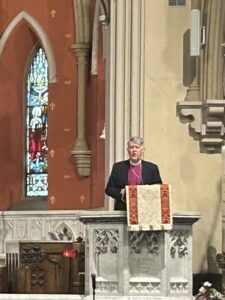
This fall, Christ Church celebrated the 1700th Anniversary of the Council of Nicaea with a public lecture and panel discussion. The Rt. Rev. Bill Franklin, PhD, Assisting Bishop of Long Island and retired Diocesan Bishop of Western New York, presented on “The Unity of Nicaea.”
Bishop Franklin argued that the legacy of Nicaea is not confined to the past. Each time the Church proclaims the Nicene Creed, it reaffirms the conviction forged in that council: that Jesus Christ is fully God and fully human, the Savior of the world. The creed functions as a unifying declaration across time, space, and culture, linking Christians today with those who gathered in Nicaea nearly 1,700 years ago.
The council also serves as a reminder that the Church has always faced disagreement and division. Unity has never meant uniformity, nor has the pursuit of truth been free from conflict. Yet the willingness of the Church to gather, to debate earnestly, and to seek common confession remains a defining mark of Christian witness.
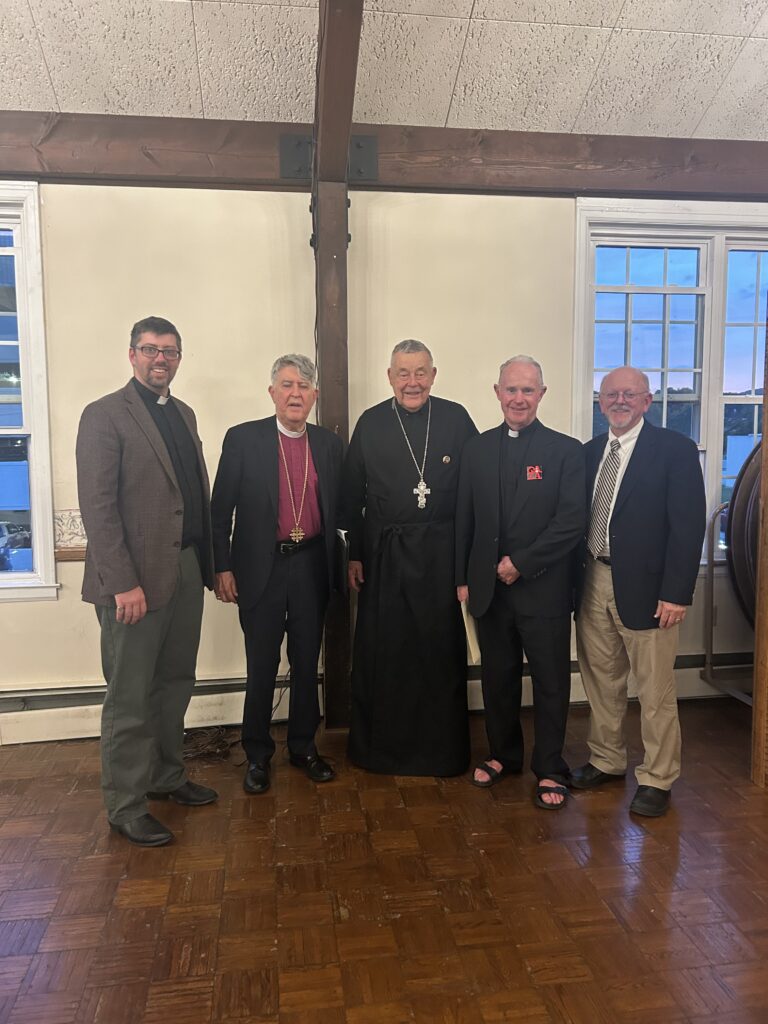
Following Bishop Franklin’s address, there was a panel discussion in Great Hall moderated by Fr. Scott Parnell. In addition to Bishop Franklin, the other panels were (from left to right): Fr. Jim Dutko (Orthodox), Fr. Tim Taughter (Roman Catholic), and Rev. Gary Hansen (Presbyterian)
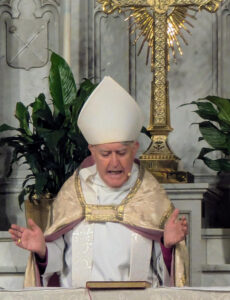
The next morning, Bishop Franklin then celebrated and preached for our 10:00 a.m. worship service. In his sermon, Bishop Franklin encouraged us to pursue unity in our faith: that even when difficult decisions must be made, that so long as they align with the Gospel vision, unity is forged through our faith in Christ.
A special thank you is due to all who made this event possible.
The History of Nicaea
The Council of Nicaea was held in 325AD in modern day Turkey. It was conviened by the Emperor, Constantine and assembled Bishops from across the Roman Empire.
The years preceding the council were marked by dramatic change for the Christian community. For centuries, Christians had endured periods of persecution, sometimes forced to worship in secrecy, and often regarded with suspicion by Roman authorities. That changed in 313 with the Edict of Milan, in which Emperor Constantine legalized Christianity throughout the empire. With imperial favor, the Church rapidly grew in visibility, influence, and responsibility.
The Arian Controversy
This newfound legitimacy also revealed deep divisions. Different regions had developed distinct practices and theological emphases. Of these, none was more disruptive than the debate sparked by a priest in Alexandria, Egypt, named Arius.
Arius was a gifted preacher whose teaching drew significant attention. He argued that Jesus, the Son of God, was not eternal but created by the Father before time began. In Arius’s view, “there was a time when the Son was not.” This implied that the Son, though exalted above creation, was not fully divine in the same sense as the Father.
This teaching struck at the very heart of Christian belief. If the Son were a creature rather than truly God, could Jesus truly reveal the Father? Could he truly redeem humanity? Could God really identify with our suffering? Bishop Alexander of Alexandria, and his deacon Athanasius, successfully argued that Arius’s theology undermined salvation itself. They insisted that the Son is eternal, uncreated, and of the same divine essence as the Father.
To address the crisis, Constantine summoned bishops from across the Christian world to meet in the city of Nicaea (in present-day Turkey). This was the first time such a gathering had occurred. Approximately 300 bishops attended, some traveling from as far away as Britain and North Africa.
The Emergence of the Creed
The central question was clear: was the Son fully God, or was Arius correct in stating that he was a created being? After vigorous debate, the council overwhelmingly rejected Arius’s position. The bishops declared that the Son is “begotten, not made, of one being/substance (homoousios) with the Father.”
This phrase—“of one substance”—was decisive. It affirmed that Christ is not a lesser divine being but fully God, co-eternal with the Father, and therefore able to accomplish salvation. The council’s decision was codified in a statement of faith, which formed the foundation of what we now know as the Nicene Creed. (The creed was later expanded at the Council of Constantinople in 381, but its essential framework was established at Nicaea.)
Additional Decisions
While the Arian controversy was the primary reason for convening the council, the bishops also addressed other matters of importance:
- The Date of Easter: Communities had long differed on how to calculate the date of Easter. The council sought uniformity, declaring that Easter should be celebrated on the same Sunday throughout the Church, distinct from the Jewish Passover. This decision did not entirely end the disputes—differences in calculation between East and West persist to this day—but it represented a significant step toward common practice.
- Church Order: The council recognized the authority of certain bishops—later known as patriarchs—over broader regions, thereby creating greater organizational stability.
- Clerical Discipline: Several canons were issued concerning the conduct of clergy, including regulations about ordination, transfer between dioceses, and ascetical practices.
Aftermath and Legacy
Although the council’s decision was clear, the controversy did not immediately disappear. In fact, debates over Arian theology continued for decades, with emperors and bishops alternately supporting different sides. Athanasius, who had been a key opponent of Arius, spent much of his life in exile for his defense of the Nicene faith. It took nearly a century for the Nicene understanding of Christ’s divinity to be universally accepted in the Church.
Nevertheless, the Council of Nicaea established a precedent of extraordinary importance: when faced with division, the Church could gather in council, guided by the Holy Spirit, to deliberate, discern, and proclaim the truth of the gospel. It also set the pattern for subsequent ecumenical councils, which would go on to address other doctrinal and pastoral challenges.
Leave a Reply