

“The Word became flesh and dwelt among us.” – John 1:14
Every Christmas celebration makes two claims: the first historical, the other theological. The historical claim recounts, well, the history. It remembers a series of miraculous events from the salutation of the Angel Gabriel to the Holy Family’s flight into Egypt, with the central moment being the birth of Jesus in Bethlehem. This the focus of carols and crèches — but truly has little value without the theological claim behind it. While Matthew and Luke’s gospel recounts the history, John’s account begins in the esoteric. There is talk of a divine word that was in the beginning, through which all things came into being.
And it’s true, the Hebrew Scriptures recount the moment of Creation as the effect of God speaking: “Let there be light.” Every subsequent day God spoke and creation appeared, like a painter bringing a canvas to life. This culminated in the desire of God to make something unique out of the Creation. “Let us make human kind in our image,” God spoke, “in our likeness.”
This claim of “being in God’s image” was a scandal. Only kings and emperors could bear the divine image. To share this likeness would challenge everything and force a reordering of the world as we know it. And yet, this is the very claim the divine Word makes — that we each bear the divine image.
The celebration of Christmas is when these two claims collide. It is when we surrender to the hope that the Creator became part of the Creation. No longer would it be just the Pharaohs and Caesars who bore the divine image, but every member of the human family. To honor God now meant to honor one another – to strive for justice and peace among all people, and respect the dignity of every human being.
Ironically, it was the mundaneness of Jesus’ birth that truly set it apart. It was God stepping into our humanity, as a helpless child, that allowed us all to begin remembering that one another bares divine image. And we do have to remember it, for certainly, there are people for whom we consistently reject that image. This is why the claim of Genesis – affirmed in Jesus – is a scandal.
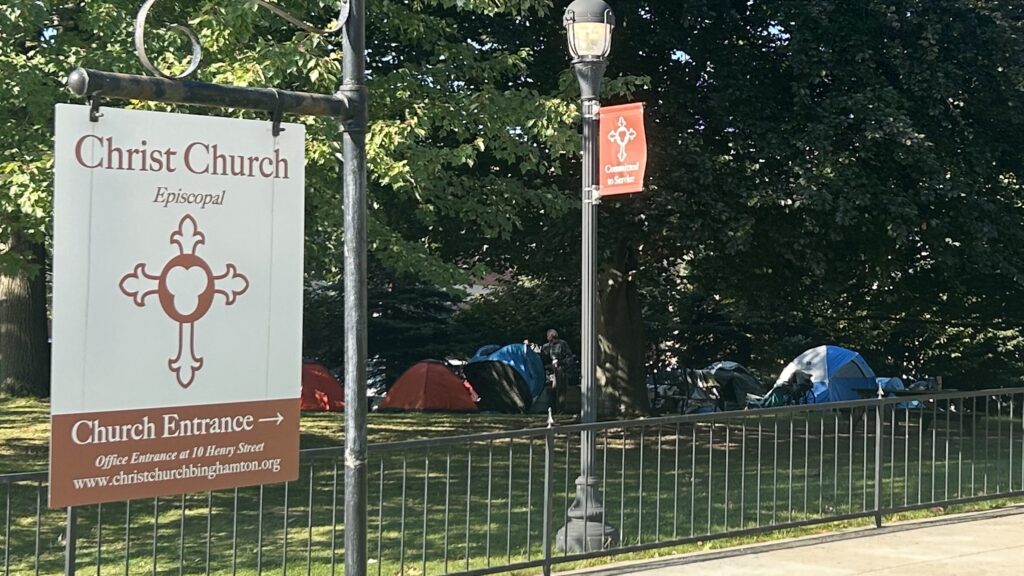
It is also why we welcomed many people to our Church this summer. The rejection of their humanity – their autonomy, right to self-determination, agency, and the like – was plentiful. The justifications for this were legion: they’re dirty, they’re dangerous, they’re a public health liability, they’re a leech on society, they don’t belong here. And truthfully, we must be honest that these utterances were from those who had forgotten that every human being bears the divine image and that our salvation is wrapped up together.
“Hey, you! Why don’t you get a job”
“Go back to where you came from.”
“Not in my city.”
These were all things overheard when someone saw a tent at the Church.
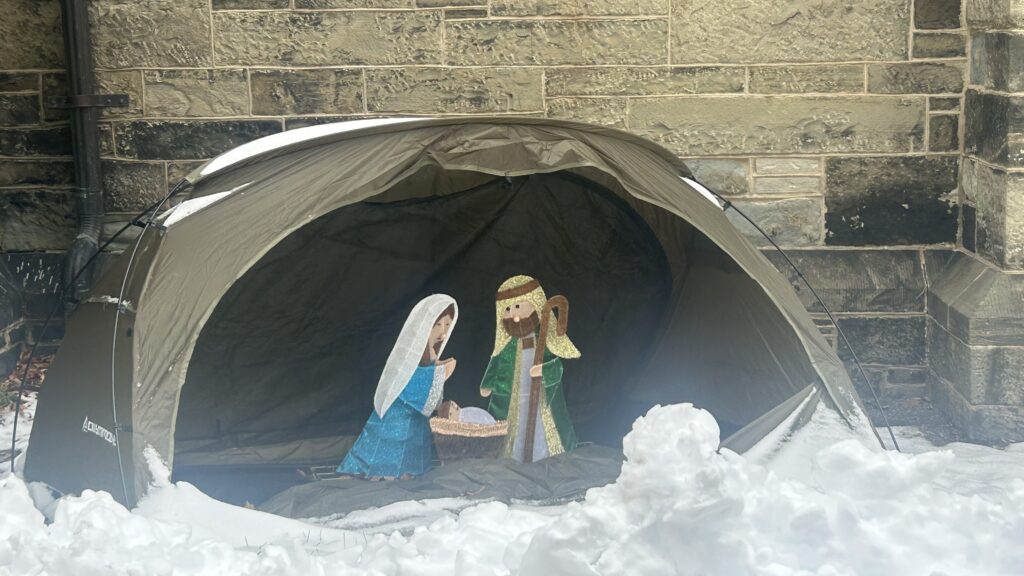
So you can then imagine the surprise this Advent when the corner was turned and the unsuspecting realized it was Jesus asleep in the tent. An implicit question was raised: If I can see a depiction of God in this tent, then why can’t I see the human?
I heard people call this nativity a monstrosity. How dare we put Jesus in a tent like one of them, as if our imagined cave or barn is more authentic or historically accurate. Mary and Joseph were forced to travel ~90 miles by foot (taking anywhere from 4 to 10 days) from Nazareth to Bethlehem, and there were neither Embassy Suites nor Econolodges along the way.
We also romanticize the stable where Jesus was laid. We hear songs about the sweet barnyard animals that nay as Jesus fell asleep on the hay. If being born in a stable is what really happen, it would have been miserable. It would have been cold, dirty, and humiliating… no different than someone’s best option being to sleep in a tent. It is a call to see the humanity in us all.
The miracle of Christmas presses beyond a virgin birth and rests in the hope that God stepped into our existence — that the Creator became part of the Creation. For in doing so, God affirmed the divine image in each and every person (even those in tents). Remember it was Jesus who taught, “whatever you do to the least of these, you do unto me.”
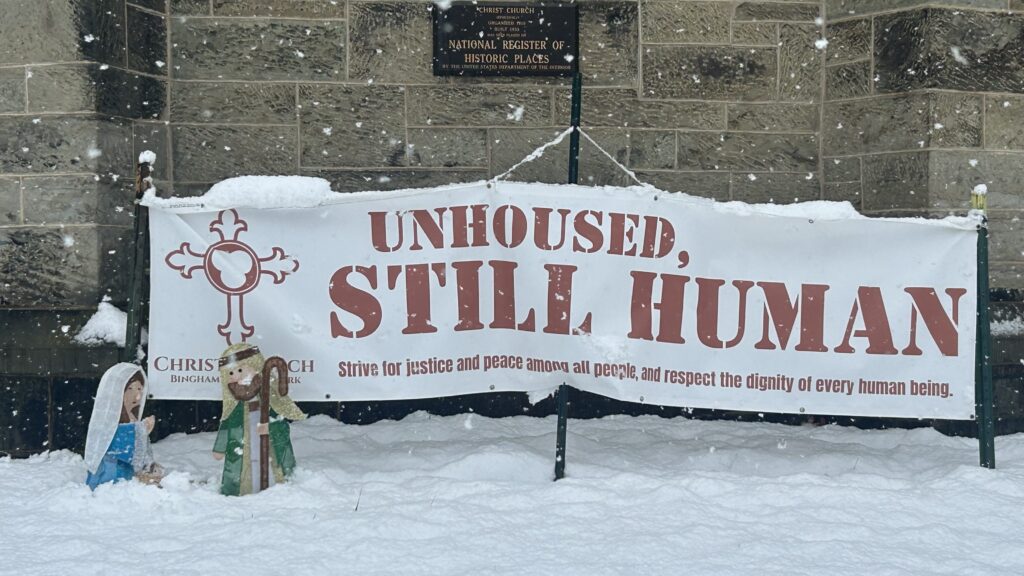
Last Sunday, Mary and Joseph lost their tent – another divine image bearer needed it. The figures of our nativity were neatly placed against the church, and the space where the tent had laid was empty. Once again, a symbolic moment of God giving of himself so that we might have life. There the Holy Family was displaced once again, going from place to place, asking if there was room.
Solving our City’s housing crisis will take work, intentionality, and a reprioritization of values – and truthfully there are only a handful of people in a position to take action. And, this work will only have a chance, if we as individuals can make room. So this Christmas season, let us make room. Let us open our hearts and eyes to begin seeing God in every person we meet. Let us see the human – the divine image bearer – and let us response with love and compassion.

Leave a Reply