

As we come to the close of 2025 and reflect back on the year, our congregation’s involvement in Binghamton’s housing challenges remains a priority. However, solving these challenges are not something we can tackle alone — it takes a coalition of people of goodwill to address these challenges and minister to those caught in their wake.
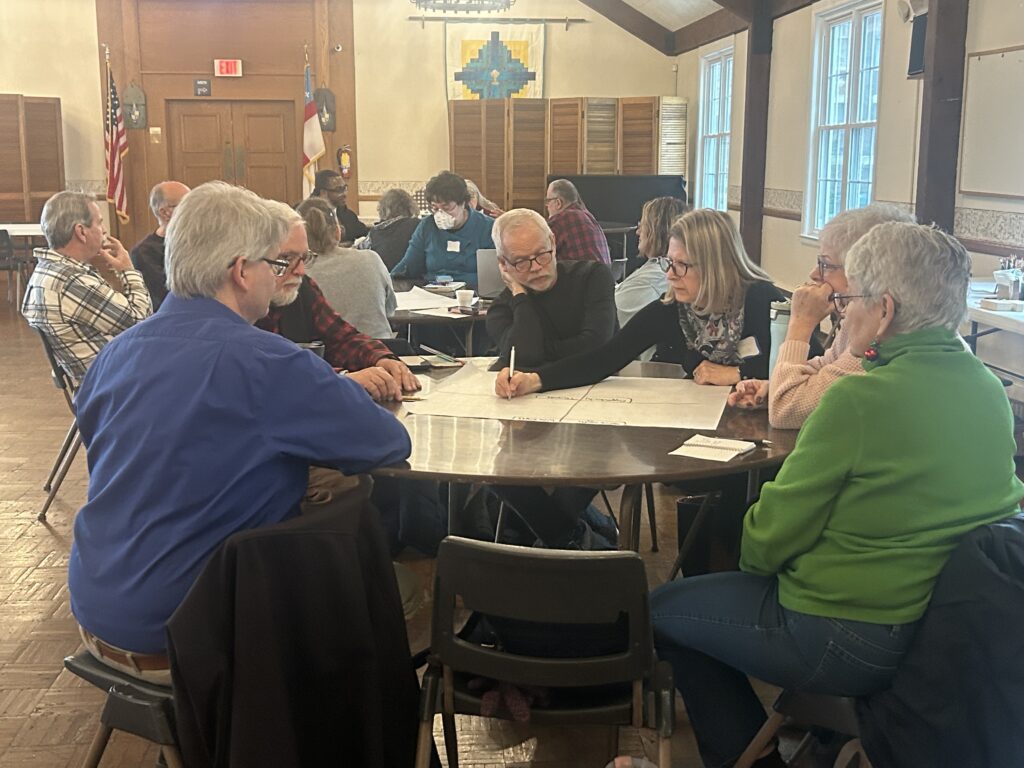
This month, an initial gathering took place at Christ Episcopal Church of faith leaders from five congregations who are committed to serving the lowly of Binghamton. The congregations represented included: Christ Episcopal Church, First Christian Church of Binghamton, Unitarian Universalists of Binghamton, Trinity Memorial Episcopal Church, and Trinity AME Zion Church.
The conversation was lively and inspiring. With nearly 25 individuals present, each person represented a different outreach initiative. Projects currently being led include food pantries, clothing closets, bus pass assistance, soup kitchens, and emergency winter warmth. After each person was able to gather and share their involvement, the plenary then broke into small groups to complete a SWOT assessment of current supportive services in Binghamton.
Following the completion of the SWOT assessment, those gathered then shared their findings. The consistent greatest strength each working group identified was the passion and enthusiasm of our amazing volunteers: our congregations could not do what they do without you! We likewise shared our perceived weaknesses, opportunities, and threats.
At the conclusion of the meeting, we resolved to continue this important work. And now, looking ahead to 2026, there is important work on the horizon. Other congregations have learned about this gathering, and are interested in joining the conversation. The next meeting is scheduled for mid-January, where we hope to do a similar activity — but then assign working groups to address some of the weaknesses and explore the opportunities.
This collaborative work gets to the core of community development, where we can make positive change by working together. This all beings with a basic assumption that Binghamton already has what it needs to address its housing challenges. At this point, it’s about choosing to work together and actively addressing the problem. If we want to build a better future for our community, we must care for all members of our community.
Asset Based Community Development
Asset-Based Community Development (ABCD) is an approach to strengthening communities by focusing first on what they already have, rather than on what they lack. Instead of beginning with problems, needs, or deficits, ABCD starts by identifying and mobilizing existing assets—skills, relationships, institutions, and local resources—that can be harnessed for positive change.
At the heart of ABCD is the belief that communities are not empty vessels waiting to be fixed by outside experts. Every neighborhood has people with talents and knowledge, informal networks of care, faith communities, businesses, and organizations that contribute to the common good. ABCD encourages residents to recognize these strengths and connect them in new and creative ways.
Practically speaking, this might mean mapping the skills of community members, identifying shared spaces that can be used for gatherings or programs, or partnering local organizations to address shared goals. Outside support—such as grants or professional expertise—can still play an important role, but in ABCD it comes alongside community leadership rather than replacing it.
By emphasizing participation, relationships, and local ownership, Asset-Based Community Development fosters dignity, resilience, and long-term sustainability. When people see themselves as contributors rather than clients, communities become better equipped to respond to challenges and to shape their own future together.
Leave a Reply