This past week, United Way of New York State and Broome County released its 2026 “State of ALICE” Report. The report details data on individuals and families that are classified as “Asset Limited, Income Constrained, Employed” (ALICE). This is the fancy way of saying that these individuals have a job, participate in the local economy, but fail to make enough income to cover very basic living expenses.
This year’s data indicates that 44% of Broome County holds an ALICE designation. Using the same thresholds and reconciling it against federal income data, we can make an educated guess that this figure increases to roughly 62% of the City of Binghamton.
The release of this data is a good excuse to learn a little more about ALICE, social support, and the role that Christ Church plays in supporting these ALICE families.
Who is ALICE?
The ALICE designation is a shorthand way of summarizing an individual or family’s financial status in relationship to their particular cost of living. The ALICE threshold considers rent, food, transportation, health care, etc. Essentially, what it costs to actually live in today’s world (this is the basis of what is meant by “a living wage”).
One of the major components of the ALICE threshold is the consideration of childcare. Childcare is expensive (trust me, I know!). Childcare for working parents is also necessary (trust me, I also know!). As children move out of full-time care into grade school, the cost of childcare decreases. The ALICE threshold accounts for this circumstantial factor in how they calculate the figure – because it’s not a “cookie-cutter” one-size-fits-all determination.
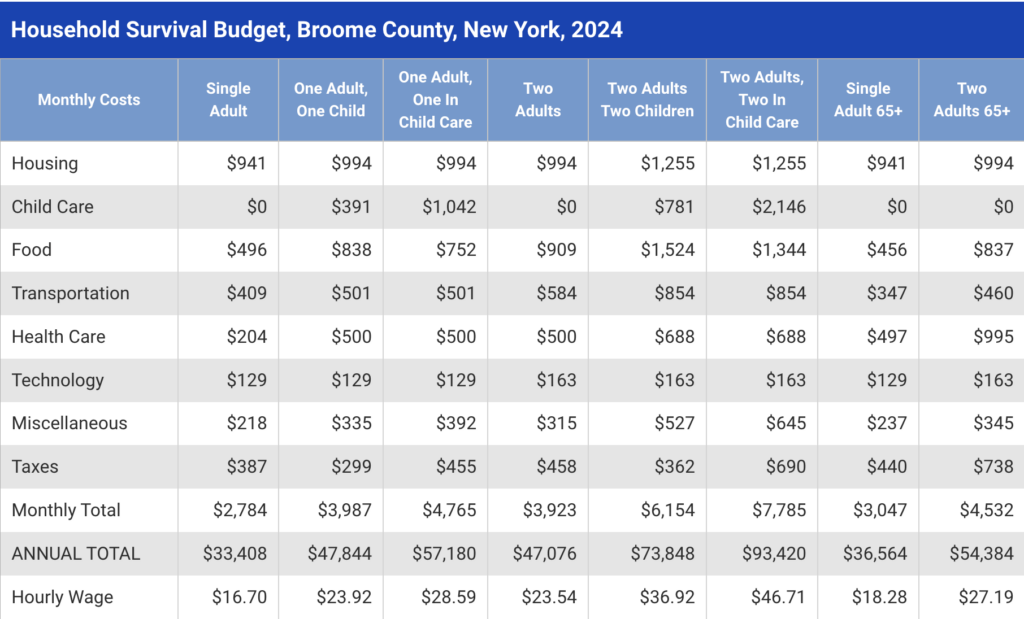
As you can see in this chart from the United Way, household budget is determined by number of adults, number of children (and specifically how many children are in childcare). Notice, for instance, that a family of four with two children in childcare needs a minimum annual salary of $93,420. Once those children move into kindergarten, that same family only needs a minimum salary of $73,848. Reflecting reality, the monthly childcare cost drops nearly $1,365, while simultaneously increasing the food costs by $180 (because as kids get bigger, they eat more).
At the same time, though, healthcare costs and transportation costs seem like wishful thinking. The monthly transportation estimate for a single adult is $409. In today’s economy, can you imagine having a car payment, automobile insurance, and paying for gas (not to mention oil changes, maintenance, etc.), all for $409 per month? Likewise, find me a health insurance premium for an individual for $204 per month.
Long story short – the ALICE threshold isn’t perfect, but it does a significantly better job of estimating the true cost of living for individuals and families than the poverty line does.
Wait, so what’s the poverty line?
The “poverty line” is a federal designation for where social support services should start/stop. The determination of where the poverty line falls is based on a 1963 assumption that food costs should be one-third of expenses. Just to tease that out, if one-third of our expenses are food, and another third are for housing (the standard industry assumption), then that leaves one-third for all of those other categories identified by ALICE: transportation, childcare, etc.
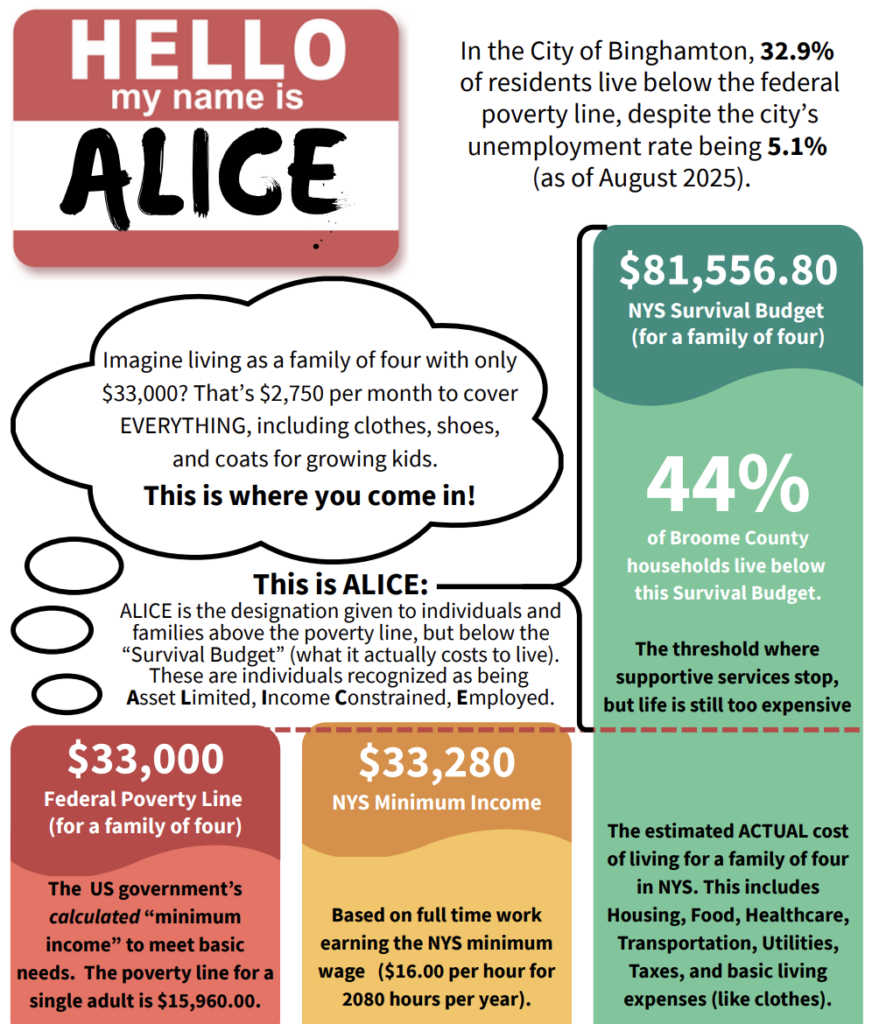
One monthly bill cycle is enough to convince us that the poverty line (again, defined as 3x a minimal food budget) is a gross underestimation. To put real figures on it – the federal poverty line for a single individual is currently $15,960. This means that any income above $15,960 begins to disqualify you from social support services. That’s right. Based on how our system is set up, if you make more than $15,960 per year, then you become disqualified from assistance, even though we reasonably know that $15,960 is only half of what it reasonably costs to actually live (the $33,408 that ALICE identifies).
If you’ve ever heard accusations about people choosing not to work more because they’ll lose their benefits – this is why. The chasm between the federal poverty line (with benefits) and the living wage (without benefits) is gigantic. This is why NYS has set its minimum wage to $16.00 (compared to the $7.25 federally). That $16.00 is close to what the living wage threshold suggests ($16.70).
So why don’t we change the poverty line? Well, because we’ll realize a lot more people will classify as “poor,” and then whatever social services we choose to offer as a society would have to adjust and expand to meet this significantly higher number – in Broome County’s case, an increase to 44% of the population.
Speaking of Social Support, how does that work? (And yes, this is a heavily simplified answer.)
There are effectively two flows of federal money that finance social support programs: the Department of Housing and Urban Development (HUD) and the Department of Agriculture (USDA). HUD deals with housing and supportive services (1.2% of federal budget); USDA deals with SNAP (1.4% of federal budget).
For us, NYS and the Broome County Department of Social Services (DSS) assigns SNAP benefits directly to the recipient. HUD moneys are a little bit different, where some money flows to the local government and others flow through the overarching Continuum of Care (CoC). For instance, earlier this year there was discussion about United Presbyterian Church receiving a Community Development Block Grant (CDBG). This grant money goes from HUD directly to the City to then distribute. Other housing projects/support services will make a proposal to the CoC, where it then is evaluated and determined if it goes to the federal level to compete for funding.
The challenge with this funding is that it is all grant-specific. In other words, if you notice a need that falls outside the scope of the grant, you cannot use those grant funds to meet that need. This is where organizations like the Community Foundation and United Way are so important – because they add the next layer of granting (generally for relatively smaller projects – like Katie’s Closet). The final layer of funding is private donors. And donors are incredibly important, because most of the HUD grants require community support (e.g., “Match Funding”).
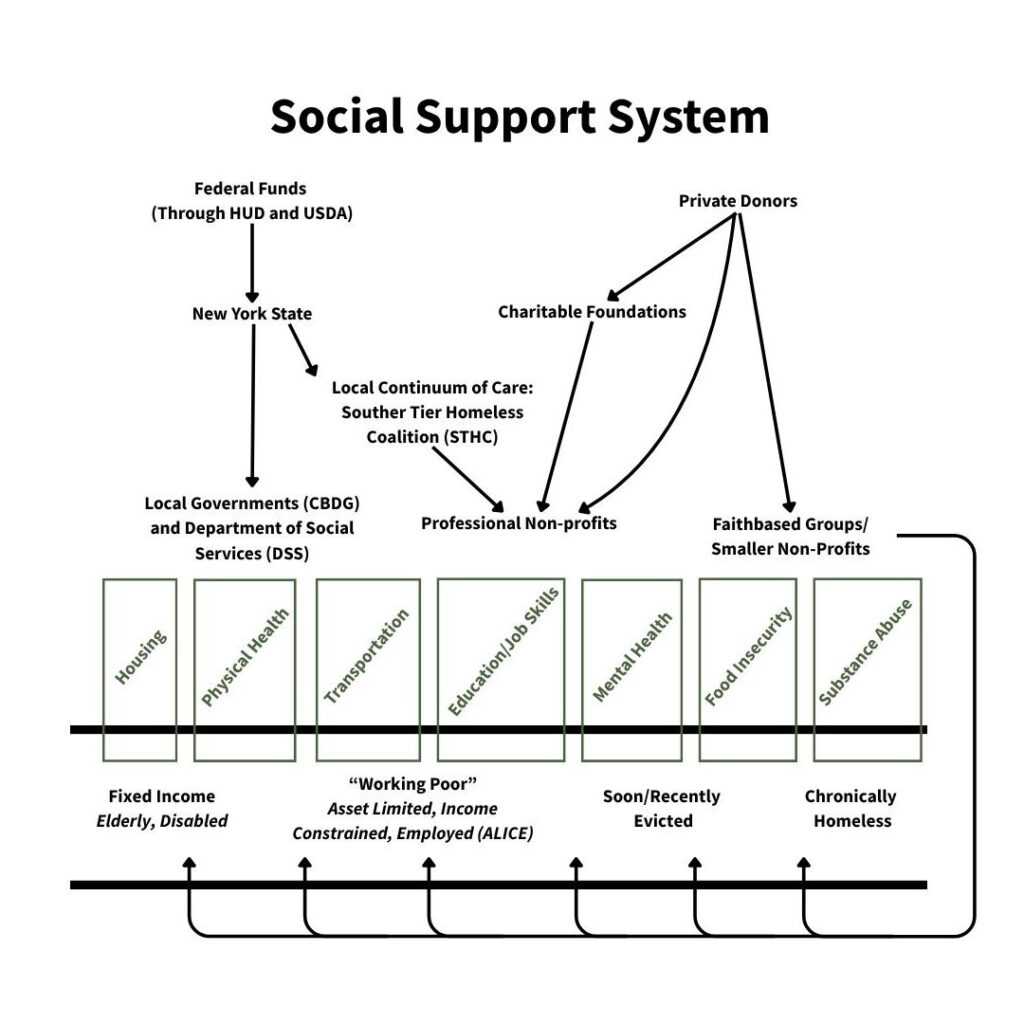
In a local context, it is the non-profits and government agencies that do a lot of the heavy lifting of social support. For example, in 2025, NYS received approximately $7 billion in HUD funding (approximately 12% of the HUD budget). These social support programs address housing, mental health, physical health, education and job skills, transportation, substance use, etc. However, because these are grant programs that are locked into what the grant is written for – it is extremely difficult to adjust and meet emergent needs.
This is where we come in. Because we are not grant-funded, we are able to step in and help fill the gaps between these categories. Take our Food Pantry as the example. As someone begins to earn more than the poverty line, they begin to lose SNAP benefits – despite the obvious impossibility of being able to economically survive (this goes back to the ALICE measure). When we, as a congregation, bring in food or financially support the pantry, we are providing food to folks who make too much to get support, but not enough to purchase the food themselves. This allows them to spend their income on other necessities.
This same thought applies to Katie’s Clothing Closet and Neighborhood Basics (our emerging hygiene pantry). We are trying to provide a tangible product (whether food, clothing, or shampoo) to allow income to be allocated to other needs. I can say from experience, the annual investment in winter coats for growing children is an expensive venture, and probably economically perilous for those under the ALICE threshold – because at the same time energy costs are increasing.
The Role of the Church in All of This
As you can tell, this is a complex system with multiple moving parts that is simultaneously trying to adjust to a shifting context. If you look at the figure explaining the social service funding, you’ll see the types of people receiving assistance between two thick lines. These are the elderly, disabled, ALICE, those experiencing insecurity, and those unhoused. Everything above the top line is what we would consider the work of justice. Everything below the thick line falls under the category of charity. Survey the soup kitchens in Binghamton – they are singularly sponsored by faith-based organizations.
Justice and charity work hand-in-hand – and from the Christian perspective are both necessary. Jesus talks an awful lot about caring for the poor (in our world, the people between those two bold lines). He pushes us as His disciples to find and embrace the Kingdom of God that exists in between those bold lines, because it is found in the people between those lines. And we find the Kingdom of God there by (1) offering charity and (2) working for justice. In other words, much like our baptismal covenant, we are to (1) seek and serve Christ in all persons, loving our neighbor as ourselves, and (2) strive for justice and peace among all people and respect the dignity of every human being.
Take the adage of “give a man a fish, feed him for a day; teach a man to fish, feed him for a lifetime.” Using this same heuristic of “above the line” and “below the line,” we can see that charity is giving the fish to meet the needs of that immediate day (what is below the line). The justice work, being above the line, is the teaching. The work of the Church in influencing the justice work is to say, “teaching a man to fish is great – but we also need to provide him with the fishing pole.” To teach a man to fish is great, but to do it without providing the necessary tools is a slap to his dignity.
This means that when we have the opportunity to offer charity, we should take it. It’s why we as a community are so focused on serving our neighbors through our ministries (i.e., our Food Pantry and Katie’s Closet). It’s the role that we comfortably play within the system and for the system. Think what would happen if all of the churches in Binghamton shut down their soup kitchens or food pantries… we serve the system, too.
Simultaneously, it is why when we are presented with the opportunity to influence the system above the bold lines, we also have to take it – because that opportunity for justice work is not as frequent, but is equal in importance to the charity.
The work of the Church in this world is a be a sacramental assurance to all people of God’s eminence and reign. Being honest about where we are – as the United Way report was — is the right first step. Now it is time for us to take the next step and respond.
More on that, later…