This July, the Anglican Consultive Council (ACC) met in Belfast to discuss the future of the Anglican Communion. For the average Episcopalian, this probably does not raise a lot of eyebrows: we’re Episcopalian, we go to worship into our local parishes as Episcopalians, and we might notice when something interesting happens in the broader life of the Episcopal Church. Very rarely does something come up that impacts our individual lives on an international level. However, as a congregation, we are incredibly diverse. We have multiple members of our parish that grew up in other parts of the Anglican Communion – and so what happened in Belfast in July is actually quite relevant to our common congregational life.
What is the Anglican Communion?
The Anglican Communion emerged out of the expansion of the British Empire. Following the English Reformation in the sixteenth century, the Church of England became the established church of England. As England—and later Great Britain—established colonies around the world, Anglican chaplains accompanied the colonists as part of the settlement in the Mid-Atlantic. The clergy were there to serve English colonists, and they remained under the ecclesiastical jurisdiction of the Bishop of London, who was responsible for Anglican congregations outside England. My last congregation was an example of this: founded in 1652 in the Virginia Colony. The congregation still has the original letter from the early 1700s written by Bishop of London authorizing one of their early Rectors to ministry in Virginia.
As the colonies expanded, however, the arrangement between the Bishop of London and colonist-clergy became increasingly impractical. Eventually, bishops were appointed to serve in colonial dioceses throughout North America, the Caribbean, Africa, Asia, and the Pacific. Interestingly enough, the first Rector of my previous parish, Alexander Murray, was the first such designee, but he died before he could be ordained a Bishop in the 1670s. The dioceses with designated bishops remained connected to the Church of England but gradually developed their own leadership and institutions.
A decisive turning point came after the American Revolution. Because Anglicans in the newly independent United States could no longer swear allegiance to the British Crown (as was required by the Oath of Supremacy and Allegiance), they organized the “Foreign and Domestic Missional Society (colloquially known as The Episcopal Church) in 1789 as the first autonomous Anglican church outside England. Our first bishop, Samuel Seabury, was consecrated in 1784 in Scotland by the non-juring bishops of the Scottish Episcopal Church (the non-juring Bishops meaning those who refused, themselves, to swear allegiance to the Crown). The English Parliament would later change the law requiring an oath, allowing William White and Samuel Provoost to be consecrated in England in 1787. The three American bishops could now ordain new bishops, and thus gave way for The Episcopal Church to formally exist.
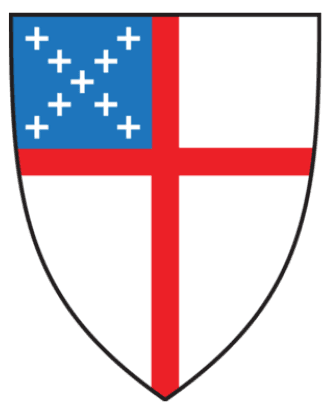
This piece of history is why the Episcopal Shield combines St. George’s Cross (the national flag of England, the red cross with white field) with St. Andrew’s Cross (the national flag of Scotland, white diagonal cross on blue field) – the nine crosses that form the “X” of St. Andrew’s Cross represent the nine original diocese of The Episcopal Church.
Throughout the nineteenth century, churches in other parts of the British Empire gradually became self-governing provinces with their own bishops, synods, and constitutions. Rather than functioning as colonial branches of the Church of England, these churches became autonomous while remaining in communion with one another. This development gave rise to what is known as the Anglican Communion—a worldwide fellowship of self-governing churches united not by centralized authority but by shared worship, episcopal succession, and common heritage.
The first Lambeth Conference, convened by Archbishop of Canterbury Charles Thomas Longley in 1867, provided an important expression of this growing communion. Bishops from across the world would gather every ten years to consult on matters affecting the Church, although the conference was intentionally given no legislative authority. Check out the Diocese of Central New York’s post about the 2022 Lambeth Conference. In 1930, under the leadership of Archbishop Cosmo Gordon Lang, the Lambeth Conference published this definition of what was meant by the Anglican Communion:
The Anglican Communion is a fellowship, within the one Holy Catholic and Apostolic Church, of those duly constituted dioceses, provinces or regional Churches in communion with the See of Canterbury, which have the following characteristics in common:
a. they uphold and propagate the Catholic and Apostolic faith and order as they are generally set forth in the Book of Common Prayer as authorized in their several Churches;
b. they are particular or national Churches, and, as such, promote within each of their territories a national expression of Christian faith, life and worship; and
c. they are bound together not by a central legislative and executive authority, but by mutual loyalty sustained through the common counsel of the bishops in conference.
Lambeth 1930, resolution 49
In the post-War World II world, where British colonies began quickly gaining independence, the way the Communion operated needed to evolve. In 1968, Lambeth established the Anglican Consultive Council, a body of lay persons, bishops, priests, and deacons to meet every three years (this is the same body whose current work inspired this post). Then in 1979, then-Archbishop Donald Coggan established the Primates Meeting for recognized Primates (chief bishops) of the communion to gather on a regular basis. The ACC and Primates meeting, along with the Lambeth Conference and communion with the Archbishop of Canterbury represent what are today known as the “Instruments of Communion.” Participating in these three bodies (Lambeth, ACC, and Primates’ Council), along with being recognized by the Archbishop of Canterbury made one a member of the Communion.
The Emerging Conflict
This was all well and good, until theological disagreements began to emerge in the late twentieth century – namely, women’s ordination and same-sex marriage. The Province of Hong Kong and Macao first authorized women’s ordination in 1971, followed by The Episcopal Church in 1976. Fast-forward to 1994 and the Church of England began ordaining women. More conservative provinces in the Communion started distancing themselves over this disagreement, claiming that women holding pastoral authority was contrary to Scripture, and thus in conflict with “the Catholic and Apostolic faith.” Then in 2003, when the Episcopal Church consented to the consecration of Gene Robinson, a larger rift began to appear.
In 2008, more conservative members of the Communion gathered for the “Global Anglican Future Conference” (or GAFCON). This cohort established their own “Primates’ Meeting” and created their own network: the rupture within the Communion began to materialize. Then, in 2009, GAFCON recognized the recently formed Anglican Church in North America (ACNA) – the name taken on by the various congregations and dioceses who left the Episcopal Church, including Good Shepherd in Vestal.
So here we can begin to see the problem that the ACC’s meeting is trying to resolve. The Episcopal Church maintains communion with the Archbishop of Canterbury and thus is the official member of the Anglican Communion in the United States (and beyond). The ACNA, while claiming to be Anglican, has never been formally recognized by the Archbishop of Canterbury, but it is, however, recognized by the larger African provinces who are recognized by the Archbishop of Canterbury.
In 2018, the ACC passed a resolution which commissioned the Inter-Anglican Standing Commission on Unity, Faith and Order (IASCUFO) to explore theological questions around “structure and decision-making to help address our differences in the Anglican Communion.” The fruit of this work is the Nairobi-Cairo Proposals (first published in December of 2024), which is being deliberated at this week’s ACC meeting in Belfast.
This all has gotten significantly more complicated since 2018, because in 2023, the Church of England permitted the use of Prayers of Faith and Love. This document serves as a resource for same-sex couples to “give thanks for their relationship” but not sacramentally bless their relationship. The Church of England’s explicit clarification of the purpose and use of that resource to be an act of thanksgiving, but not of solemnization, reflects the tension they found themselves between the two poles. Then, finally, six months before this year ACC’s gathering, Sarah Mullally was elevated to Archbishop of Canterbury: the global Anglican communion was now anchored by (gasp!) a woman.
So, July’s ACC meeting was a gathering of the communion leaders (lay and ordained) to discuss how we move forward despite theological difference. At the core of this, is a question of Anglican identity
Forging an Anglican Identity
Defining Anglican identity has always been a challenge. If we start with the establishment of the Church of England, the argument was how to define the practice in terms of Catholic or Protestant. In the early years (and depending on the reigning monarch) the church oscillated back and forth between the two extremes, with fights taking place over various theological claims. It was under Elizabeth I that an idea of an authentic Anglican identity of via media or “middle way” began to take hold.
Under the Elizabethan Settlement, both Catholic and Protestant formulations appeared in the liturgy – and we still have these today. The Eucharist Prayer clearly claimed that the Bread and Wine became the Body and Blood of Christ (the Roman Catholic influence), while also including Jesus’ charge to “do this in remembrance of me” (the Protestant influence).
Today, we understand our Anglican identity as a continuation of this, where we universally hold certain theological convictions, and we simultaneously recognize how the application of those consistent convictions can differ in our practices. This is how we can worship together, affirm the same creed, take the same baptismal vows, and hold differing perspectives on various social issues. We embrace the maxim: “In essentials unity, in non-essentials liberty, in all things charity.” Where the Anglican Communion is struggling is to discern the line between those things which are essential, and those that are not.
To make the real conflict blunt and direct, the question the Anglican Communion is trying to gain consensus on is whether (1) the ordination of women and (2) same sex marriage are essential or non-essential things for the faith. The challenge is that each side grounds their argument in overtly essential things, namely the Baptismal Covenant (the core of the Tradition) and the Scriptures. The supportive side rests on our baptismal covenant, where we “strive for justice and peace among all people and respect the dignity of every human being”; the opposing side argues that scripture “clearly” forbids both and therefore because scripture is primary, it cannot be. (For the record, those are “air quotes” around clearly). And our struggle is, is that as time has gone on, each side is more and more convinced that the practical application of the Covenant and the Scriptures (two essential things) forces us to hold each of these conflicting applications as essential – thus we have the rift.
Resolving the Challenge
In an attempt to reconcile this, the Inter-Anglican Standing Commission on Unity, Faith and Order (IASCUFO) proposed the Nairobi-Cairo Proposals, which were discussed at July’s meeting. The Nairobi-Cairo Proposals were an attempt to rethink the structure and identity of the Anglican Communion in response to the significant divisions that have emerged among Anglican churches around the world. They recognized that the Communion has become a genuinely global body rather than a collection of churches organized primarily around the Church of England and the Archbishop of Canterbury. They therefore called for a more polycentric Communion, with multiple centers of leadership and authority that better reflect the diversity of Anglicanism around the world.
A central idea is “differentiated communion”: Anglican churches do not necessarily have to agree on every theological or ethical issue in order to remain in communion with one another. Provinces may reach different conclusions on matters such as the ordination of women or same-sex marriage while continuing to pray together, cooperate in mission, recognize one another as Anglican churches, and maintain appropriate relationships. The proposals also envision a changed role for the Archbishop of Canterbury. Canterbury would remain an important historic and spiritual center, but communion with Canterbury would no longer necessarily be the primary definition of membership in the Anglican Communion. This represents a significant movement away from a centralized, historically colonial model toward a more genuinely global understanding of Anglican identity. The metaphor that is being used is that Canterbury is the “parent church,” and that when the children are little, the parent needed to have a heavy hand – except it was the Church of England the colonial provinces. However, the children-churches have all grown up, therefore the relationship with the parent needs to change.
The Nairobi-Cairo Proposals are therefore less an attempt to resolve the Communion’s theological disagreements than an attempt to provide a way for Anglicans to remain together despite those disagreements. Their underlying conviction is that Christian unity does not require complete uniformity, and that Anglicans can “walk together” even when they understand some theological questions differently. The proposals were not adopted wholesale at the ACC meeting in July; instead, the Council called for continued discernment and dialogue, allowing relationships and trust to develop further. In that sense, Nairobi-Cairo represents a possible new vision for Anglicanism: a decentralized, post-colonial, worldwide communion held together not by uniformity or centralized authority, but by shared faith, relationships, and a commitment to walk together.
To me, the Nairobi-Cairo Proposals speak to the core and strength of our Anglican tradition where we learn to disagree while maintaining relationship. This is a skill and quality that our world desperately needs, and one I believe that we can model faithfully. When someone asks me why I’m Episcopalian and not Catholic or Protestant, I enthusiastically respond, “because I don’t need everyone to agree on everything.” In essentials unity, in non-essentials liberty, in all things charity.
Beloved, this is the strength of our tradition and the strength of our congregation. As the ACC continues to deliberate how the communion understands itself, let us continue to embrace who we are as faithful inheritors of the Anglican tradition in Binghamton, and beyond.